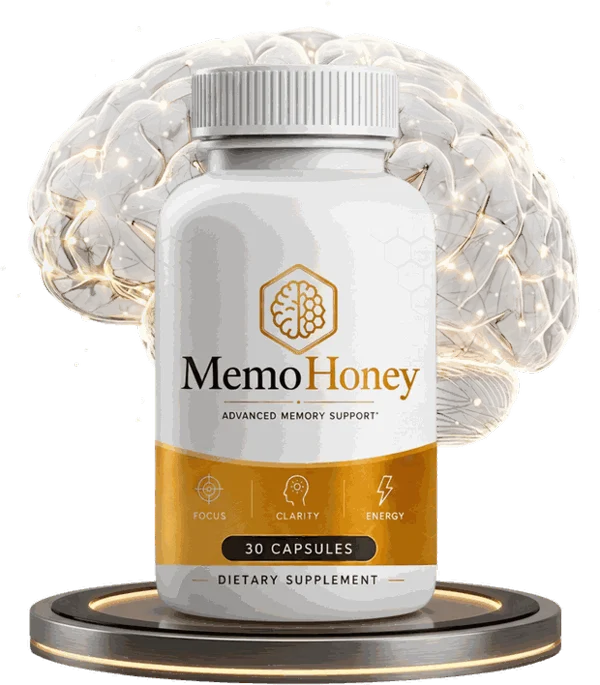
Product photography from one of MemoHoney's own marketing sites. Different storefronts print different ingredient panels under this same bottle design, documented below.
- What it is: a once-daily capsule marketed for "memory, focus, and mental clarity," bundled into single-bottle, three-bottle, and six-bottle checkout tiers, each backed by a 60-day refund window. That packaging structure is the one thing every version of this product agrees on — what's actually in the capsule is where the agreement stops.
- What the label leaves out: the storefront we could actually order from lists seven ingredient names in paragraph form, with no supplement-facts panel and no milligram amount printed anywhere on the page you'd checkout from.
- What we found checking the seller: more than a dozen near-identical marketing domains, three different claimed company identities with no page linking them together, and a checkout button that routes through a third-party affiliate-tracking domain rather than a company you can look up.
Three ingredient panels, one bottle design
Search for MemoHoney and you'll find it described three different ways, depending on where you look. We're calling them List A, B, and C so the rest of this page can refer to them without repeating the full ingredient names each time.
| List | Where it appears | Named ingredients | Honey or cinnamon? |
|---|---|---|---|
| A — amino-acid formula | The live checkout storefront, and a syndicated label-disclosure press release (Aug 2026) | L-Arginine, L-Arginine AKG 2:1, L-Citrulline HCl, L-Citrulline Malate, Niacin (B3), Calcium, Beta-Alanine | No |
| B — nootropic formula | Independent product-review coverage, not the live checkout page | Bacopa Monnieri, L-Theanine, Ginkgo Biloba, Rhodiola Rosea, Phosphatidylserine | No |
| C — honey-botanical formula | Separate independent coverage, tied to "honey ritual" marketing framing | Astaxanthin, Ginkgo Biloba, Bacopa Monnieri, honey, blueberry | Yes |
The version that's actually easiest to buy right now — List A, live on the storefront we checked — is the one with no honey and no cinnamon at all, despite the name and despite marketing elsewhere built around an "ancient honey ritual" concept. A syndicated press release does publish milligram amounts for List A (Niacin 7.5 mg, Calcium 18 mg, L-Arginine 200 mg, L-Arginine AKG 2:1 200 mg, L-Citrulline HCl 100 mg, L-Citrulline Malate 100 mg, Beta-Alanine 40 mg) — but that press placement is not the page you'd actually check out from, and the live storefront itself prints none of those numbers.
What the research actually says about each named ingredient
Rather than accept or dismiss "memory support" as a category claim, we looked at what each of the ten distinct compounds named across all three lists is actually studied for — separate from what any bottle claims for itself.
| Ingredient | List | What the research actually looks at |
|---|---|---|
| L-Arginine / L-Citrulline (both forms) | A | Amino acids studied mainly for nitric-oxide production and blood flow — the same mechanism used in exercise-"pump" and blood-pressure supplements. This is a real, separate research area, but it isn't a memory-specific mechanism, and none of these four ingredients appear in any published memory or cognition trial we could find. |
| Niacin (B3), Calcium, Beta-Alanine | A | Niacin and calcium are basic nutrients with established roles at deficiency-correcting doses, well below what's typically studied for cognitive effects. Beta-Alanine's research base is almost entirely about muscular endurance during high-intensity exercise, not memory. |
| Bacopa Monnieri | B, C | The strongest human evidence in this entire ingredient set. Randomized, placebo-controlled trials using standardized extract at 300–450 mg/day for 12 weeks have found improvements in verbal learning and delayed recall versus placebo. |
| Ginkgo Biloba | B, C | The largest dedicated trial — the NIH-funded Ginkgo Evaluation of Memory (GEM) study, over 3,000 older adults followed for years — found 120 mg twice daily did not reduce the rate of dementia or Alzheimer's compared to placebo. Ginkgo has other studied uses, but dementia/memory prevention isn't one where it panned out. |
| Phosphatidylserine | B | One of the better-supported ingredients here for an already-declining population specifically: multiple placebo-controlled trials in elderly adults with memory complaints or cognitive decline found improvements on recall and cognitive-function measures, with a favorable safety profile in the trials we reviewed. |
| Rhodiola Rosea | B | Its evidence base is mostly about fatigue and stress resilience, not memory. One well-conducted randomized trial in students found no cognitive improvement after 20 days at studied doses — the human cognition evidence specifically is thin and mixed, despite a larger animal-study literature. |
| L-Theanine | B | Best studied for promoting calm, focused attention — usually in combination with caffeine. It's a real, mild effect on attention, not a memory-formation or recall effect specifically. |
| Astaxanthin | C | Small human trials are genuinely mixed: one 2026-reviewed trial found no overall cognitive benefit in middle-aged adults after 8 weeks, though a subgroup under 55 showed improved word recall. Evidence in humans remains limited and inconsistent. |
| Honey | C | A randomized trial of Tualang honey specifically (not honey generically) in healthy women found improved immediate verbal recall versus placebo, but not delayed recall — a modest, ingredient-specific result, not evidence for honey as a category. |
Put the table above next to the storefront you can actually order from, and the mismatch is direct: the formula you can buy today (List A) contains zero of the ingredients with any real memory-specific research behind them. The two ingredients with the most substantial human evidence for memory outcomes — Bacopa Monnieri and Phosphatidylserine — only show up in secondhand coverage of List B, a formula we could not find being sold on any live checkout page ourselves. A reader who searches "MemoHoney ingredients" and finds a writeup describing Bacopa Monnieri is very likely reading about a different bottle than the one the "Buy Now" button on a MemoHoney storefront will actually ship.
Who actually sells it
MemoHoney isn't sold from one stable web address. We found it presented as "the" official site on more than a dozen near-identical domains, styled with small spelling variations, extra letters, region prefixes, and different extensions — the same manufactured-scarcity mirror-site pattern we've documented on other single-name supplements. Digging into who stands behind those storefronts turned up three separate claimed identities, and no page anywhere reconciles them into one:
- No company named at all on the storefront we reviewed in detail — its footer reads only a bare copyright line, no legal entity, no address.
- A distributor name and a Utah PO Box, disclosed only in a syndicated label-disclosure press release, not on the storefront itself — and that same release lists two different ZIP codes for what should be the identical PO box, in the same document.
- A third, differently named LLC in Idaho, cited elsewhere with its own state registration number, as the entity selling MemoHoney.
No single page, on any storefront, names all three and explains how they relate. In practical terms, there is no one "MemoHoney the company" a buyer can research ahead of time — only a rotating cast of storefronts and identities, and no way to know in advance which one a given order will actually route through.
Claims that don't hold up when checked
Two specific claims on the storefront we reviewed are worth flagging directly, because they're checkable facts, not matters of opinion:
- "FDA Approved." One storefront's trust badge and its own FAQ state the product "is approved by the FDA before being marketed." Dietary supplements don't go through an FDA approval process the way prescription drugs do — the agency's actual role here is limited to registering the facility that manufactures a supplement, a paperwork step that says nothing about whether the finished product was tested or found effective. The same storefront page uses the more accurate "FDA-registered facility" phrase elsewhere, which is what makes the "approved" language look like a deliberate upgrade rather than careless wording. A separate write-up published this same month, checking the same storefront independently, flagged the identical discrepancy.
- A perfect "5.0 out of 5" rating from tens of thousands of reviews. A five-star graphic sits next to a review count running into the tens of thousands, but nothing on the page links out to where those reviews live or lets a visitor open even one of them. We can't call that fabricated — only unverifiable as displayed, and a spotless average at that volume would be statistically remarkable for almost any product, let alone one with three conflicting ingredient lists behind it.
Set against those unverifiable claims is one specific, named one we could verify: a Trustpilot reviewer using the name "Jo Jo B." left a one-star review dated August 24, 2026, of a MemoHoney storefront, stating that none of the ingredients listed on the website were actually in the capsules they received. We can't confirm that experience for every buyer or every storefront — but it lines up directly with the three-conflicting-formulas problem documented above.
Separately, and worth naming honestly rather than either overstating or ignoring: consumer-protection reporting from outlets including Snopes, NBC affiliates, and the Better Business Bureau has documented an active AI-deepfake scam campaign — sometimes called the "cinnamon and honey ritual" — using fabricated video of Bill Gates and other public figures to sell honey-based "memory cure" products, a pattern our own Deep Dive coverage elsewhere has tracked in more detail. MemoHoney's name has turned up in consumer fact-checks discussing that broader scam family. Tracing one specific deepfake ad all the way through to a checkout page for this exact bottle wasn't something we could pull off ourselves, so we're stopping short of calling it a confirmed match — but paired with everything documented above, it tips the balance further away from recommending a purchase, not toward it.
Guarantee and pricing, as the seller shows it
We aren't selling MemoHoney through this page, and nothing here is monetized by MemoHoney — this is only what the seller's own pages show, reproduced so the sections above make sense in context.
$79/bottle — 1 bottle, plus shipping
$69/bottle — 3 bottles, free shipping
$49/bottle — 6 bottles, free shipping
The stated guarantee window is 60 days from purchase. Given that at least three company identities and a dozen-plus domains are associated with this product, and that the one place a distributor address is disclosed contains a ZIP-code inconsistency in its own text, confirming exactly who is on the other end of a refund request is a real, separate step — not a formality.
This is the seller's own checkout pricing, not an Amazon link. Modern Biology News doesn't process this purchase, doesn't control this pricing, and earns nothing from it.
A transparently-dosed way to look at the ingredient with the strongest evidence
Of the ten compounds named across MemoHoney's three ingredient lists, Bacopa Monnieri comes out ahead on human evidence specifically tied to memory — which is also the reason it's notable that List A, the formula actually sitting on the checkout page, skips it entirely. Two small but real randomized trials shape what's known: a 12-week study published in the Indian Journal of Psychiatry tracked older adults with age-related memory concerns on a twice-daily 125 mg standardized dose and reported gains in logical memory and paired-associate learning against placebo. A second, shorter six-week trial using 300 mg total daily (split into two 150 mg doses) found working-memory and logical-memory scores moved significantly in the treatment group versus placebo.
None of that rises to a cure, and none of it applies to a diagnosed memory disorder — both trials studied healthy or mildly-affected adults over a matter of weeks. What it does offer is something MemoHoney's own checkout page doesn't: a milligram number attached to a published outcome, on a label you could actually check against it.
See it on Amazon →Modern Biology News participates in the Amazon Associates program and may earn from qualifying purchases at no extra cost to you. The button above opens a live Amazon search rather than one product we've picked out for you — compare listings for a standardized extract with a stated milligram dose, since availability and sellers shift over time.
Questions we got asked directly
So which ingredient list is actually in the bottle I'd receive?
Based on what we could verify directly from a live checkout page, it's List A — the amino-acid/nitric-oxide formula with no honey, no cinnamon, and none of the memory-specific botanicals described in other coverage of this product.
Does any version of MemoHoney contain real honey or cinnamon?
Only List C, which we found described in separate independent coverage tied to "honey ritual" marketing framing — not on the storefront we could actually order from.
Is MemoHoney FDA approved?
No. In the United States, dietary supplements reach store shelves without any pre-market FDA sign-off. Facility registration is the only overlap with the FDA most supplement makers ever have — a paperwork listing, not a stamp of effectiveness. One storefront's own FAQ claims the product "is approved by the FDA," which overstates that distinction.
Is MemoHoney a scam?
We can't speak to intent. What we documented — three mutually contradictory formulas under one name, no per-ingredient doses on the page you'd actually order from, three unlinked company identities with a ZIP-code inconsistency in the one that discloses an address, an inaccurate FDA-approval claim, an unverifiable review count, and a real named complaint alleging the capsules didn't match the label — is the pattern we'd want a reader to weigh before ordering.
What would you recommend instead?
For memory specifically, the ingredient with published human trials behind it — standardized Bacopa Monnieri, at a labeled dose you can check yourself — is covered further up this page.
Direct review of a live MemoHoney checkout storefront (ingredient list, pricing, guarantee language, FDA-approval claim, review-count display, checkout redirect behavior) and a syndicated Aug 2026 label-disclosure press release naming per-ingredient milligram amounts and a distributor address. Independent product-review coverage describing two additional, non-matching ingredient panels. A dated Trustpilot complaint alleging ingredient mismatch. Consumer-protection reporting (Snopes, NBC affiliate coverage, Better Business Bureau) on the AI-deepfake "cinnamon and honey ritual" scam pattern. The NIH-funded Ginkgo Evaluation of Memory (GEM) randomized controlled trial. Published randomized, placebo-controlled human trials on standardized Bacopa Monnieri extract, on phosphatidylserine in elderly adults with memory complaints, on Rhodiola Rosea's cognitive effects in a student population, on astaxanthin in middle-aged adults, and on Tualang honey's effect on verbal recall.
This article is for general educational purposes and is not intended to diagnose, treat, cure, or prevent any disease. It is not a substitute for professional medical advice. Talk to a healthcare provider before starting any new supplement, especially if you take prescription medication or manage an existing health condition. Statements about dietary supplements have not been evaluated by the Food and Drug Administration.